
Every app you use whether it’s a bank account or a TikTok feed—relies on a database. It is the digital vault where all information lives.
But not all vaults are built the same.
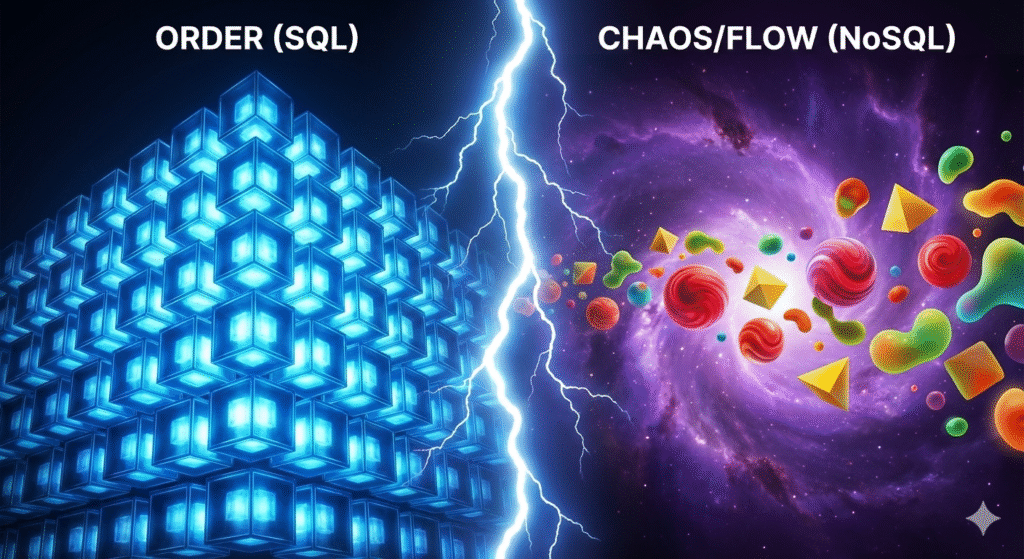
For decades, there was only one way to store data: strictly and neatly. Then, the internet exploded with messy data (tweets, likes, videos), and we needed a new approach.
This created the two main superpowers of the data world: SQL (Relational) and NoSQL (Non-Relational).
Choosing the wrong one can doom a software project before it even starts. Today, we break down the difference.
SQL: The Strict Librarian
SQL (Structured Query Language) is the traditional method. It relies on Relational Databases (like MySQL, PostgreSQL, Oracle).
SQL is obsessed with structure. Before you store a single piece of data, you must define exactly what that data looks like. You create “Tables” with strict “Columns” and “Rows.”
If you create a table for “Users” with columns for Name and Age, you cannot suddenly decide to shove a Favorite Color into one user’s record without updating the entire system.
Real World Analogy: The Filing Cabinet
Think of SQL like a strict corporate Filing Cabinet.
- You have specific folders.
- Every form in that folder must look exactly the same.
- If you want to file a document, you must fill out every required field.
- The Benefit: It is incredibly organized. You know exactly where everything is.
- The Downside: It is rigid. If you suddenly have a document that is shaped like a triangle, it won’t fit in the rectangular folder. You have to buy a whole new cabinet structure.
NoSQL: The Flexible Warehouse
NoSQL (Not Only SQL) arose to handle the chaos of modern data. Examples include MongoDB, Cassandra, and DynamoDB.
NoSQL doesn’t care about tables or strict rules. It stores data in flexible formats, often looking like JSON documents (text files with nested data). You can have one user with just a Name, and the next user with a Name, Address, and History of Purchase. NoSQL doesn’t panic; it just stores it.
Real World Analogy: The Amazon Warehouse
Think of NoSQL like a massive Logistics Warehouse.
- You have giant cardboard boxes.
- In Box A, you throw a book. In Box B, you throw a bicycle and a toaster.
- You don’t need to resize the shelves every time a new product arrives. You just find an empty spot and toss the box in.
- The Benefit: It is incredibly fast and flexible. You can store anything instantly without planning ahead.
- The Downside: It can get messy. If you need to find “every box that contains a toaster,” you might have to open a lot of boxes to check, whereas the Filing Cabinet (SQL) would have a specific index card for “Toasters.”
Comparison: When to Use Which?
Why wouldn’t everyone just use the flexible Warehouse (NoSQL)? Because sometimes, being strict is good.
1. Consistency vs. Speed
- SQL (The Bank Account): If you transfer $100 to your friend, the database must ensure the money leaves your account and enters theirs at the exact same moment. SQL is designed for this (ACID compliance). It prioritizes Accuracy.
- NoSQL (The Instagram Like): If you “Like” a photo, it’s okay if your friend in Australia sees that “Like” 2 seconds later than your friend in London. NoSQL prioritizes Speed and Scale.
2. Scaling Up vs. Scaling Out
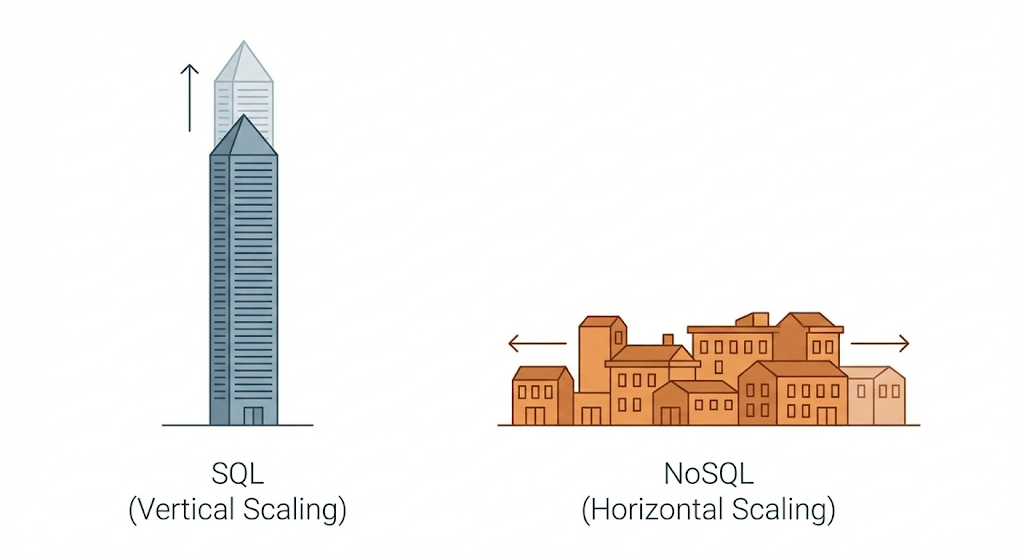
- SQL: To handle more data, you usually need a bigger, stronger computer (Vertical Scaling). Like buying a bigger filing cabinet.
- NoSQL: To handle more data, you just add more cheap computers to the cluster (Horizontal Scaling). Like renting more warehouse space next door.
Summary
- SQL is your Accountant. Strict, reliable, mathematical. Use it for financial systems, inventory management, and structured records.
- NoSQL is your Creative Director. Flexible, fast, adaptive. Use it for social media feeds, real-time analytics, and rapidly changing applications.
Most modern SaaS platforms actually use both—SQL for the billing data, and NoSQL for the user activity logs.