

When you log into Salesforce, Slack, or Gmail, you aren’t just opening a program; you are entering a massive, invisible city.
In the old days, software was like a custom-built house. You bought the CD-ROM, installed it on your server, and you owned that specific instance. If it broke, you had to fix it.
Modern SaaS (Software as a Service) is different. It is built on an architecture designed for scale, speed, and efficiency. But how does it handle millions of users simultaneously without mixing up their data?
Today, we explore the three pillars of Core SaaS Architecture: Multi-Tenancy, Microservices, and API Gateways.
1. Multi-Tenancy: The “Apartment Building” Model
The most defining characteristic of SaaS is Multi-Tenancy.
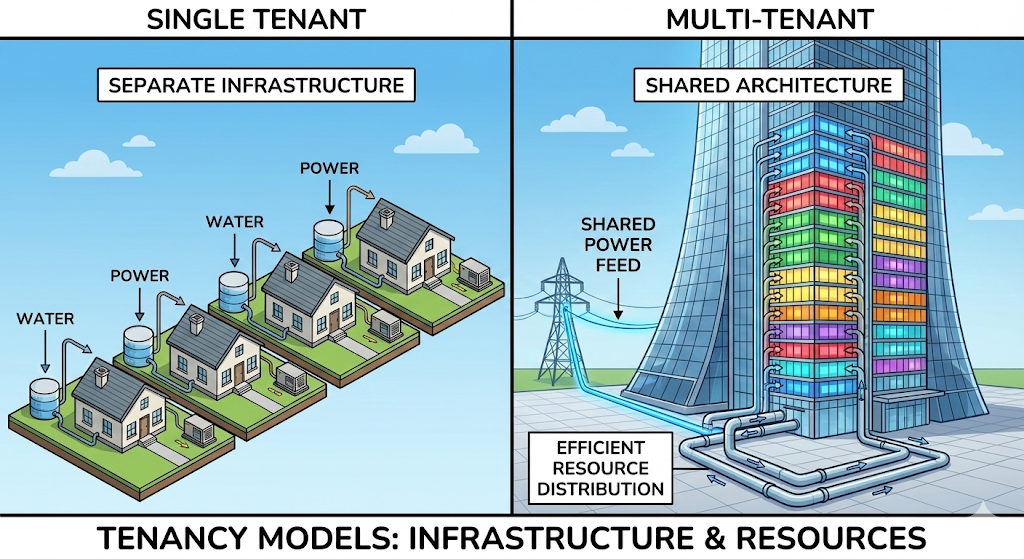
In the old “On-Premise” model, every customer got their own server. In SaaS, thousands of customers (Tenants) share the same computing resources and the same database, but their data remains strictly invisible to each other.
Real World Analogy: The High-Rise Apartment
- On-Premise (Single Tenant): Buying a detached house in the suburbs. You own the land, the pipes, and the roof. If the roof leaks, you hire the contractor. It’s private, but expensive and high-maintenance.
- SaaS (Multi-Tenant): Renting a luxury apartment in a high-rise. You share the “infrastructure” (the elevator, the plumbing, the security guard) with 500 other families.
However, your key only opens your door. Even though you share the same water pipe as your neighbor, you cannot see inside their living room.
Why this matters: It makes software cheaper and better. When the landlord (the SaaS vendor) upgrades the security system, everyone in the building gets safer instantly, without paying extra.
2. Microservices: The “Commercial Kitchen”
Early software was built as a Monolith—one giant block of code where everything was connected. If you wanted to update the “User Login” feature, you had to redeploy the entire application. If one part crashed, the whole thing crashed.
Modern SaaS uses Microservices. The application is broken down into dozens of tiny, independent services that talk to each other.
Real World Analogy: The Restaurant Kitchen
- The Monolith: Imagine a one-person food truck. The chef takes the order, cooks the burger, fries the chips, and pours the drinks. If the chef cuts their finger, the entire restaurant shuts down.
- Microservices: Imagine a professional commercial kitchen. You have a “Grill Station,” a “Salad Station,” and a “Dessert Station.”
If the ice cream machine breaks (The Dessert Service fails), the Grill Station keeps pumping out burgers. The restaurant doesn’t close; the menu just shrinks temporarily.
Why this matters: Resilience and Speed. Engineers can update the “Billing System” without accidentally breaking the “Search Bar,” because they live in different parts of the kitchen.
3. The API Gateway: The “Head Waiter”
With all these Microservices (Grill station, Salad station, Bar) running around, who coordinates them? You can’t have the customer walking into the kitchen shouting orders at the chefs.
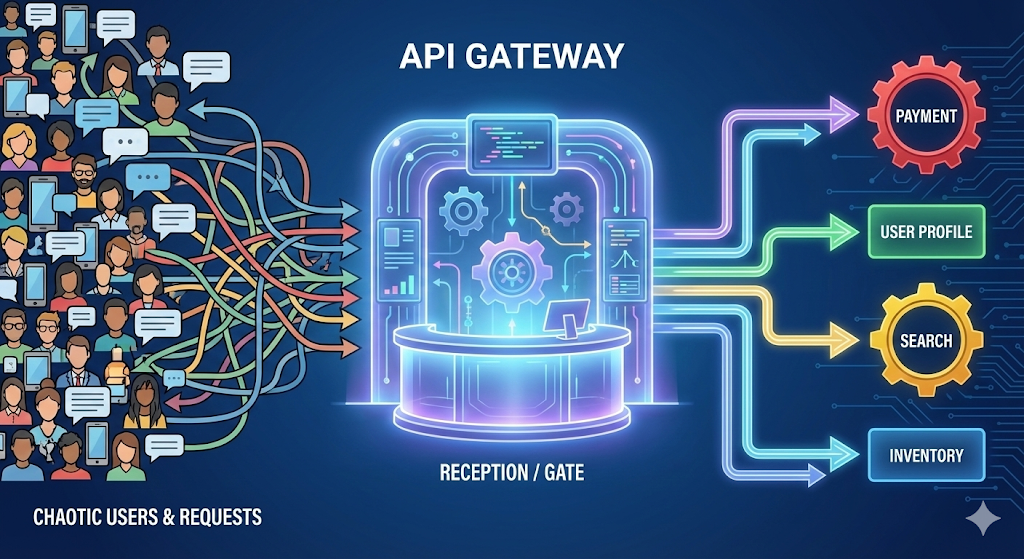
You need a front door. This is the API Gateway.
The API Gateway is the traffic cop. It sits between the user (you) and the chaos of the backend system.
Real World Analogy: The Head Waiter
When you go to a restaurant, you don’t walk to the fridge to get a coke, then walk to the grill to ask for a steak.
You sit at the table and tell the Waiter (API Gateway): “I want a steak and a coke.”
The Waiter:
- Checks if you are allowed to order (Security/Auth).
- Routes the “Steak” request to the Kitchen.
- Routes the “Coke” request to the Bar.
- Combines them onto one tray and delivers it to you.
You don’t need to know how the kitchen works; you just need to know the Waiter.
Summary
Building a SaaS product isn’t just about writing code; it’s about city planning.
- Multi-Tenancy allows us to house everyone efficiently (The Apartment).
- Microservices ensures that one broken pipe doesn’t flood the whole building (The Kitchen Stations).
- API Gateways manage the traffic so everything runs smoothly (The Waiter).
These three concepts allow modern platforms to serve millions of users globally with 99.9% uptime.