

ANN & HNSW Explained Simply: The Magic Behind Vector Search
Introduction: The Hidden Power of Vector Search
Vector search powers many things we use every day — product recommendations, image search, smart chatbots, “similar items” suggestions, and even Spotify song discovery. But most people have no idea what actually happens behind the scenes.
In this post, we’ll explain two powerful techniques— Approximate Nearest Neighbor (ANN) and HNSW—in simple language and with real-life examples. Whether you’re technical or not, you’ll understand exactly why these methods matter, and how they shape modern AI search.
1. Why Vector Search Exists
Traditional search is literal. It looks like this:
- You type: “running shoes”
- Search looks for: documents containing the exact words “running” and “shoes”
But what if someone types:
- “marathon footwear”
- “jogging sneakers”
- “lightweight trainers”
All of these mean running shoes, but the words are different. This is where vectors come in.
A vector is just a list of numbers that represents the meaning of something. Think of it as a coordinate in a massive space where similar meanings live close together.
| Text | Meaning (Vector) |
| running shoes | [0.2, -0.4, 1.1, …] |
| jogging sneakers | [0.21, -0.39, 1.09, …] |
| marathon footwear | [0.25, -0.43, 1.14, …] |
Vectors that are close together = similar meaning.
Visualizing the Vector Space
To help readers visualize this “meaning” concept, we should include a diagram here showing similar vectors clustered together.
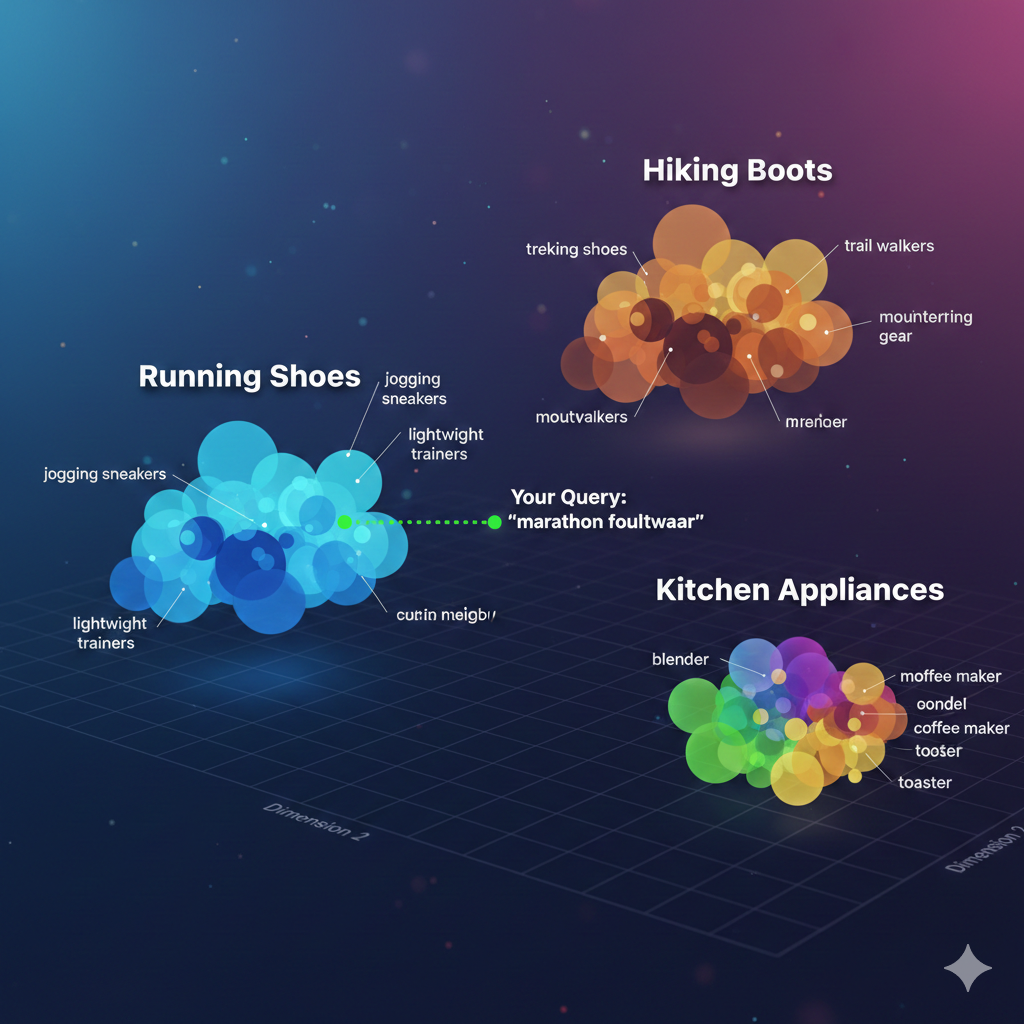
2. The Real Challenge: “How do we search millions of vectors fast?”
If you have:
- 3 million products
- 10 million images
- 200 million documents
Comparing your query vector to every single one is too slow. So, we need a smarter way.
Enter ANN — Approximate Nearest Neighbor Search.
3. What is ANN ?
ANN((Approximate Nearest Neighbor) is a fast method to find the “closest matches” to a given vector without checking everything.
It works like this:
Instead of searching every aisle in a supermarket, ANN takes intelligent shortcuts to the right aisle. You may not get a perfect answer every time, but you get very close answers, extremely fast. This is exactly what we need for AI applications where results must come in milliseconds.
4. What is HNSW?
HNSW (Hierarchical Navigable Small-World Graph) is currently the most popular ANN algorithm in the world.
It’s used by major vector databases and search tools, including:
- Qdrant
- Pinecone
- Vespa
- Weaviate
- Elasticsearch
- Many popular recommendation engines
The Supermarket Analogy (Best Way to Understand HNSW)
Imagine you’re in a giant, city-sized supermarket with 50 floors, millions of items, and no maps. You are looking for running shoes. If you search every aisle on every floor, it will take days.
Instead, HNSW works like an intelligent, multi-level navigation system:
- Start at the Rooftop (The High-Level View): You start on the top floor (which has fewer items, only broad categories). From here, you can see clusters: sports items, electronics, kitchen tools, clothing. Running shoes are likely near sports, so you go toward that direction.
- Use the Best Path Down (The Intermediate Levels): Each floor has more items than the last, but because you started from a good direction, you get closer with each step:
- High Level: “Sports section is this way.”
- Mid Level: “Running gear is this way.”
- Low Level: “Shoes are this way.”You quickly arrive at the correct cluster without wandering the whole store.
- Land on the Exact Shelf (The Base Layer): Now you are in the correct neighborhood. You only check the nearby items on that shelf. You find the actual running shoes!
This fast, intelligent navigation is how HNSW works: No full scan. No heavy computation.
The HNSW Pyramid (Mental Model)
This is the perfect spot for the pyramid diagram that illustrates the multi-level navigation:
<!-- Start Image Block: HNSW Pyramid Diagram -->
<figure class="wp-block-image size-large">
    <img src="[https://placehold.co/1200x600/6D28D9/ffffff?text=Image:+HNSW+Multi-Layer+Pyramid+Analogy](https://placehold.co/1200x600/6D28D9/ffffff?text=Image:+HNSW+Multi-Layer+Pyramid+Analogy)"
         alt="A diagram showing a pyramid structure with four levels. Level 3 (top) is broad clusters, Level 0 (bottom) is individual products."
         loading="lazy" />
    <figcaption>Fig 2. The HNSW algorithm uses a hierarchy to quickly narrow down the search space, moving from broad clusters (Level 3) to exact items (Level 0).</figcaption>
</figure>
<!-- End Image Block -->
5. Real-Life Example to Make It Clear
Let’s use our example query: “lightweight blue running shoes for marathon training”
- Traditional search finds: Anything with “running” or “blue”.
- Vector search finds: “lightweight marathon shoes,” “jogging sneakers,” “race-day trainers,” and “men’s breathable running shoes,” even if the exact words differ.
HNSW finds them FAST. Instead of checking all products, it travels the hierarchy: Top level → Sports cluster → Running gear → Shoes → Lightweight shoes in ~2–5 milliseconds.
6. Why ANN & HNSW Matter Today
These algorithms power virtually all modern intelligent applications:
🔎 Search
- “Similar products”
- “People also viewed”
- Semantic search (finding based on meaning instead of keyword matching)
🛒 E-commerce
- Fashion recommendations
- Grocery substitutions (similar items)
- B2B parts matching (bearings, motors, screws)
📷 Image & Video
- “Find images similar to this”
- Reverse photo lookup
🎶 Music
- Song recommendations
- Playlist discovery
📄 Document Retrieval
- RAG (Retrieval-Augmented Generation) for AI chatbots
Simply put: ANN + HNSW make modern, accurate, and lightning-fast AI search possible.
Summary (Very Simple)
| Concept | Simple Explanation |
| Vector Search | Finds things based on meaning, not exact words |
| ANN | Shortcut method to find similar items fast |
| HNSW | A clever graph that acts like multi-level store navigation |
| Why? | Saves time, boosts accuracy, powers AI search |
If you remember one thing: HNSW is like an intelligent guide that quickly leads you to the right neighborhood in a huge city of data.